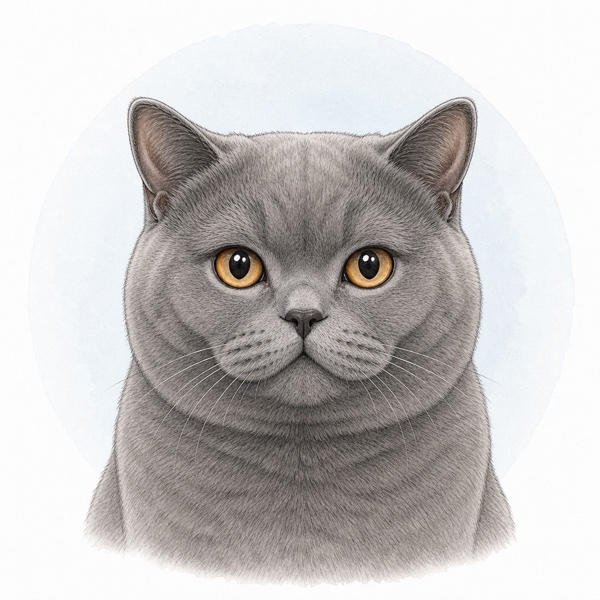
Breed compatibility guide
British Shorthair
The calm companion
Steady, independent, and quietly affectionate, the British Shorthair offers company without demanding constant physical attention.
Meet the British Shorthair
Origins and everyday rhythm
Two useful pieces of context before you decide whether this breed belongs on your shortlist.
Background
Where the breed comes from
British Shorthairs descend from long-established British domestic cats that were selectively developed in the early cat fancy. The breed is recognized for a dense coat, round features, and a powerful, compact body. Blue-gray is famous, but the breed occurs in many colors and patterns.
Daily life
What the rhythm can feel like
This is often a companion for people who enjoy quiet proximity. A British Shorthair may greet the household, supervise from a favorite chair, and accept affection on the floor while declining prolonged carrying. Calm does not mean inactive: short hunting games and food puzzles help prevent a sedentary routine from taking over.
At a glance
What life together may feel like
These are broad breed tendencies, not guarantees about an individual cat. A higher care score means more owner effort; family and other-pet scores assume respectful handling and gradual introductions.
A promising match if
Your home offers…
- You value calm, predictable companionship
- Your weekday schedule requires independence
- You prefer a quieter cat
Think carefully if
Your routine needs…
- Many prefer sitting nearby over being carried
- Their dense coat still benefits from weekly brushing
Sources and standards
Built from registry guidance, then translated for home life
We compare breed-registry descriptions with practical questions about activity, grooming, social needs, and household setup. Profiles describe broad tendencies, not medical advice or a guarantee about an individual cat.
Cat Fanciers’ Association breed library ↗TICA breed library ↗Catbreed editorial methodology →
Breed-specific setup planner
What to evaluate before buying for a British Shorthair
Catbreed maps each category to the activity, learning, and grooming scores in the profile above. We do not copy merchant descriptions or label an individual product “best” without hands-on testing. The links open broad Amazon searches so you can compare dimensions, materials, safety features, recent reviews, and current prices yourself.
Affiliate disclosure: As an Amazon Associate I earn from qualifying purchases. This does not change the price you pay. You can also use the criteria below at a local pet store, another retailer, or with secondhand equipment that can be cleaned and inspected safely.

Category guide
Secure window perch
- Why it fits
- A calmer British Shorthair can gain everyday variety from a comfortable observation point without demanding more floor space.
- What to inspect
- A mounting system suited to your window, a washable cover, enough body support, and a capacity above your cat’s weight.
- Skip or avoid
- A perch that shifts under pressure or blocks the cat’s only easy exit route.

Category guide
Supervised wand toy
- Why it fits
- Short hunting-style sessions give a British Shorthair exercise and shared attention without requiring constant high-intensity activity.
- What to inspect
- A comfortable handle, enough distance from claws, replaceable attachments, and movement your cat can safely catch.
- Skip or avoid
- Leaving string, wire, feathers, or small attachments accessible when nobody is supervising.

Category guide
Gentle weekly brush
- Why it fits
- A short or simpler British Shorthair coat still benefits from a low-pressure weekly check for shedding, skin changes, and comfort with handling.
- What to inspect
- Rounded flexible pins or soft bristles, an easy-to-clean surface, and a shape you can control with light pressure.
- Skip or avoid
- Stiff or sharp tools that scrape the skin, plus long sessions after the cat signals that it wants to stop.
Prices, availability, and listing quality change frequently. Confirm measurements against your cat and home, supervise new equipment, and ask your veterinarian or groomer when health, mobility, skin, or coat needs affect the choice.